KhmerRooms Journal · Siem Reap
Angkor Wat
អង្គរវត្ត
A KhmerRooms guide
Angkor Wat, Siem Reap
All Day
Free for Cambodians (bring ID)
Foreign friends: Angkor Pass $37 / $62 / $72 via Angkor Enterprise.
5:00 AM – 5:30 PM
Gates open at 5 AM for sunrise. Multiple entries on the same pass.
Midday sun & climbing on carvings
You have seen it a thousand times before you ever stand in front of it. It’s on the flag. It’s on the beer bottle, the riel note, the back of the school exercise book, the logo of half the businesses in town. Angkor Wat is so woven into being Khmer that it can start to feel like wallpaper — beautiful, familiar, easy to scroll past. And then you go at five in the morning, the sky behind it turns the colour of a ripe mango, those five stone towers appear upside-down in the water at your feet, and you understand why your great-grandparents thought gods had a hand in building it.
This is the largest religious monument on Earth. Not the largest temple in Cambodia — the largest anywhere, full stop. It was raised in the first half of the 1100s under King Suryavarman II, originally as a temple to Vishnu, and later eased into Buddhist worship without ever really stopping. Roughly nine hundred years of monsoons, wars, looting and jungle have rolled over it, and it is still standing, still functioning, still drawing people who fold their hands and bow at the doorways. There is no other building in the country — arguably in the region — that carries this much weight.
What most of us were never told in school is how much intention is packed into the stone. The whole complex is a model of the universe as the old Khmer engineers understood it. The central tower is Mount Meru, the mythical home of the gods. The four smaller towers around it are the lesser peaks. The wall is the edge of the world and the wide moat is the cosmic ocean. You don’t just walk into Angkor Wat; you walk across the sea, through the mountains, and up to the centre of creation. Once someone points that out, the long causeway over the moat stops feeling like a tourist queue and starts feeling like a pilgrimage — which is exactly what it was designed to be.
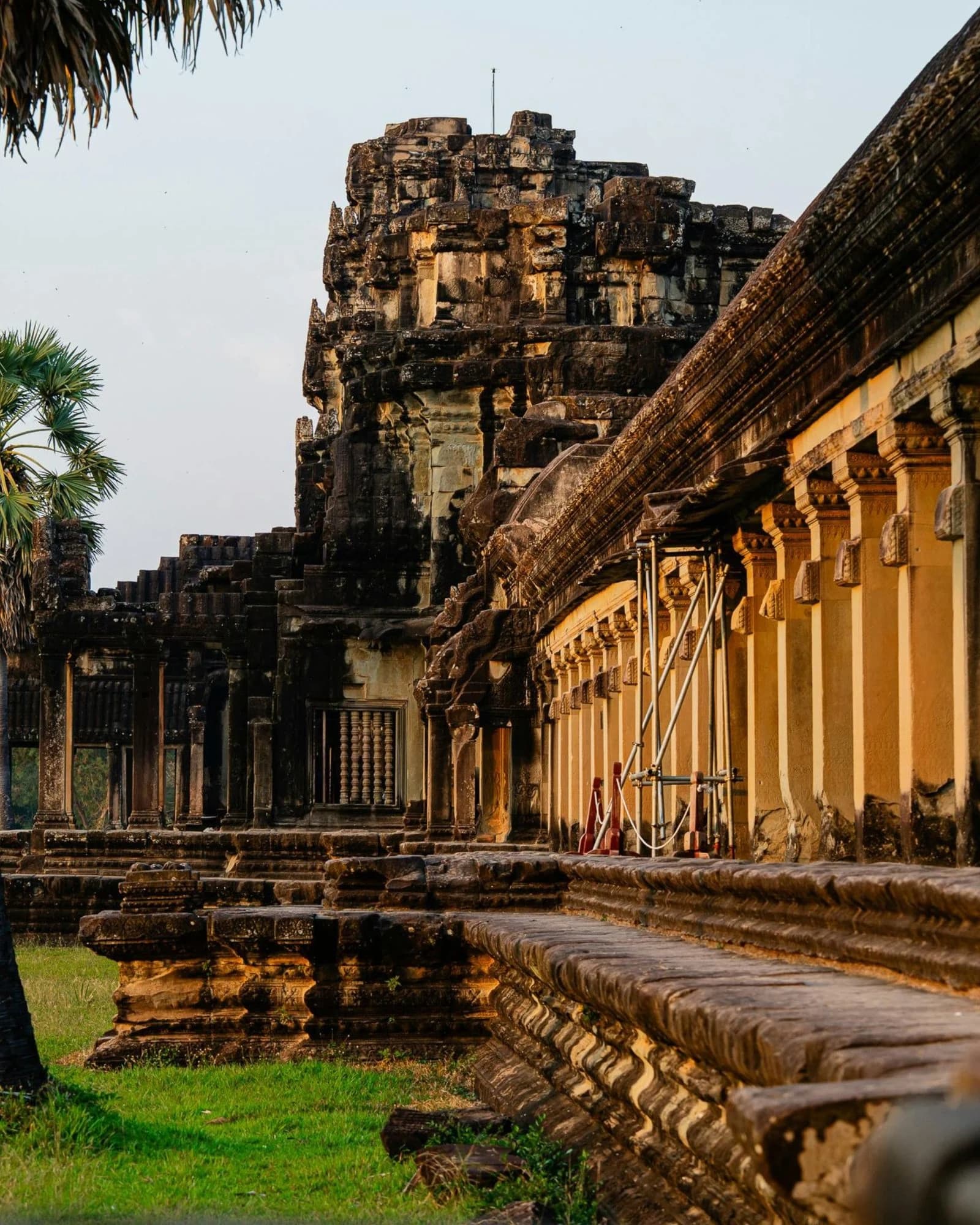
The sunrise everyone talks about
Let’s be honest about the sunrise, because the internet oversells it and undersells it at the same time. Yes, you will share the moment with a few hundred other people and a forest of raised phones. No, it is not a private spiritual experience. But when the silhouette sharpens against the colour and the reflection lands in the northern pond, the whole crowd goes quiet at the same time, and that shared hush is its own kind of magic. Aim to be at the pools by 5:15–5:30 AM. The left-hand (northern) pond usually gives a cleaner reflection; the right one dries out faster.
Don’t skip the climb to the upper level, the Bakan, the inner sanctuary at the very top of Mount Meru. The stairs are steep on purpose (reaching the gods was never meant to be easy), and there’s a modern wooden staircase now to save your knees. Up there the crowds thin, the breeze picks up, and you get the view the kings kept for themselves. One catch: the upper level has a strict dress code. Shoulders and knees must be covered, no exceptions, or the guards will turn you away at the foot of the stairs.
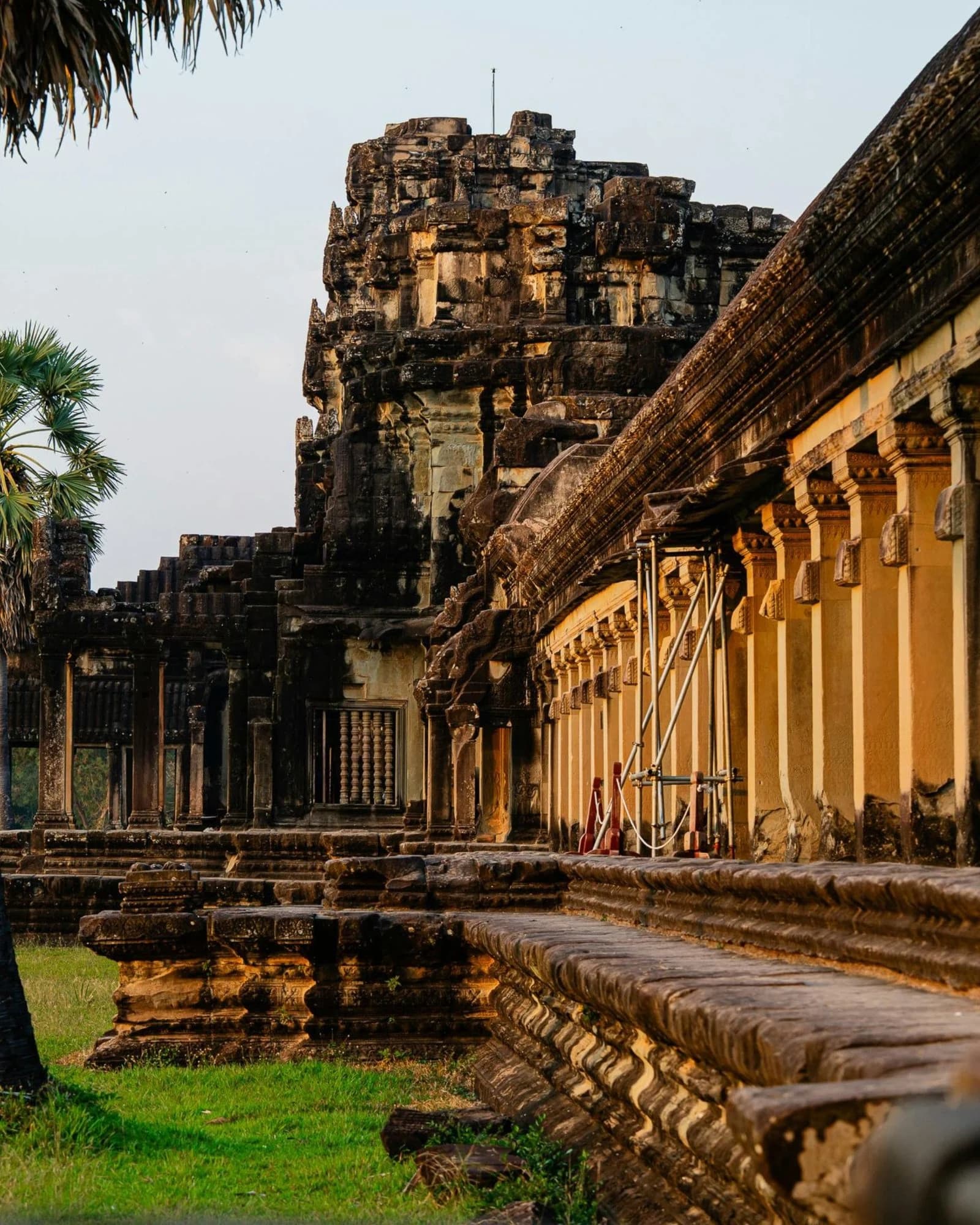
A handful of small details reward the people who slow down. There are two “libraries” flanking the main causeway, beautiful little buildings that frame the towers perfectly if you’re patient with your camera. There’s a clever local trick, too: while everyone funnels in through the grand western gate, the quieter eastern side lets you slip in against the flow and reach the centre with breathing room. Look closely and you’ll also read the temple’s harder history in the stone — Buddha statues left headless by decades of looting, a few faint bullet scars from the war years, and steady, painstaking restoration work that is still going on today. This isn’t a frozen ruin. It’s a living building that people are still mending, still praying in, still fighting to keep.
What the walls are actually telling you
The Churning of the Sea of Milk gets all the attention, but it shares those galleries with some of the greatest carved storytelling ever made. There’s the Battle of Kurukshetra from the Mahabharata, a full wall of chaos where two armies crash into each other and the stone fighters genuinely seem to be moving. There’s the Historic Procession, where King Suryavarman II himself rides out with his court, the only contemporary portrait we have of the man who built all this. And there’s the Heaven and Hell panel — thirty-seven heavens above, thirty-two hells below, with very specific, very inventive punishments carved out for the wicked.
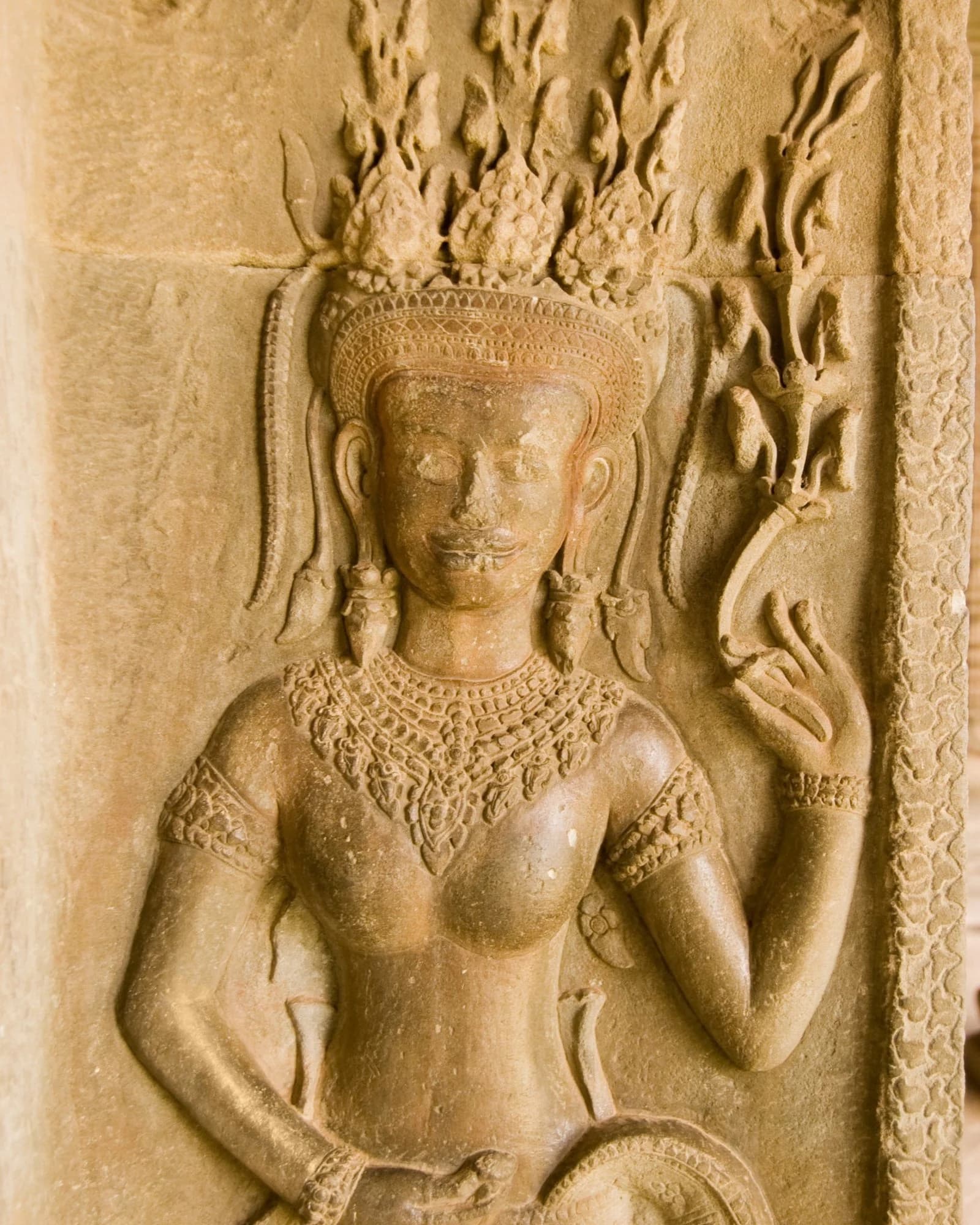
Then there are the apsaras. Over the whole complex, more than a thousand celestial dancers are carved into the walls and pillars and, the story goes, no two are exactly alike. Different hairstyles, different jewellery, different gestures, individual faces. Pick one and really look at her; someone carved that smile by hand, by lamplight, almost a millennium ago, knowing they would never see it admired. That’s the thing the postcard can never give you: the human hours inside the stone.
For us, it’s free, so use it properly
This is the line that should change how every Cambodian thinks about a weekend: Khmer nationals enter Angkor for free. No pass, no $37, no queue at Angkor Enterprise. Carry your national ID card, show it at the checkpoint, and the entire 400-square-kilometre park is open to you. Tour guides and drivers who are Cambodian don’t pay either. The Angkor Pass, the one you see foreigners wearing on a lanyard, is a foreigner’s ticket. For you, the most famous monument on the planet costs a tank of petrol from town.
The most expensive thing about Angkor Wat, if you’re Khmer, is the early alarm.
Knowing that, plan to come back more than once. The single biggest mistake people make is trying to “do Angkor” in a rushed morning and then never returning. The park holds more than ninety temples; Angkor Wat is one building of many. Treat each visit as a single chapter — sunrise one day, the bas-relief galleries on another, sunset from the side another time — and the place stops being a checklist and becomes a habit.
A few honest cautions. If you’re bringing foreign friends or family, buy their Angkor Pass only from the official Angkor Enterprise office, app, or website — fake “discount Angkor ticket” sites are a known scam, and there is no such thing as a legitimate discount. Their pass is non-transferable, carries their photo, and gets checked at every temple; a missing ticket means a real fine and no refund for a lost one. Inside, treat the stone like the nine-hundred-year-old monument it is: don’t lean on the carvings, don’t climb where you shouldn’t, and keep your voice down in the active prayer areas, because people are genuinely worshipping there. And a small, good thing to know is that two dollars of every foreigner’s ticket goes directly to Kantha Bopha Children’s Hospital, so your visiting friends are quietly funding free care for Cambodian kids just by showing up.