KhmerRooms Journal · Siem Reap
Bayon Temple
ប្រាសាទបាយ័ន
A KhmerRooms guide
Angkor Thom, Siem Reap
At the dead centre of the old royal city.
Late afternoon
Faces warm up in the low light. Green season (Jun–Sep) is quietest.
Free for Cambodians (bring ID)
Foreign friends: same Angkor Pass that covers Angkor Wat & Bayon.
7:30 AM – 5:30 PM
Plan about an hour here.
Midday sun & climbing on carvings
If Angkor Wat is the postcard, Bayon is the one that gets under your skin. You walk in expecting a smaller temple and instead you find yourself standing in a forest of stone faces — huge, calm, half-smiling — looking down at you from every direction at once. There is nowhere to stand where you are not being watched, and somehow it doesn’t feel threatening. It feels like the whole building is at peace with you.
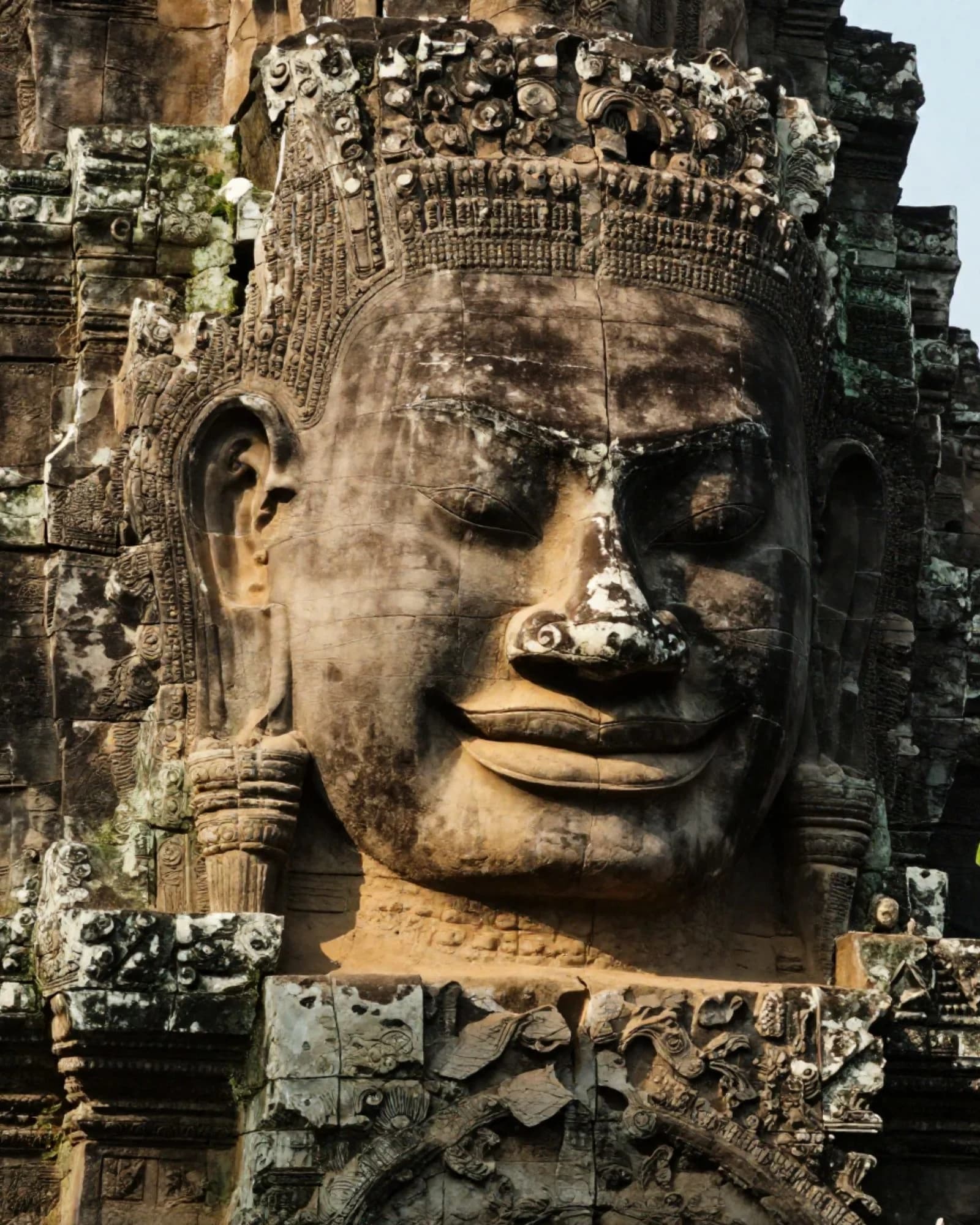
Bayon was the personal masterpiece of King Jayavarman VII, the great builder-king, raised at the turn of the 13th century as the spiritual centre of his capital, Angkor Thom. Where Angkor Wat is sharp and symmetrical, Bayon is dense, strange and a little chaotic — over fifty towers crowded together, each carrying those enormous serene faces. There are more than two hundred of them. Scholars still argue about whose face it is: the compassionate bodhisattva Avalokiteshvara, the king himself, or deliberately both at once. Most Cambodians just call it the Khmer smile, and leave it at that.
Don’t rush the lower walls
Almost everyone climbs straight to the upper terrace for the faces — and you should, because being surrounded up there is the whole point. But the part people speed past is the real treasure: the outer galleries, carved with everyday life from eight hundred years ago. Not gods and kings this time, but ordinary Khmer people. A market in full swing. A woman giving birth. Men crouched around a cockfight, money changing hands. Cooks at their fires, fishermen on the Tonle Sap, and a roaring naval battle against the Cham invaders, complete with a soldier who has fallen overboard and is being eaten by a crocodile. It is the closest thing we have to a photograph of how our ancestors actually lived.
Here’s the local move: don’t treat Bayon as a quick stop on the way to somewhere grander. Enter Angkor Thom through the South Gate — the causeway lined with rows of gods and demons heaving on a giant serpent is worth slowing down for — then give Bayon a proper hour before looping past the Baphuon, the Elephant Terrace and the Terrace of the Leper King, all within a short walk. It’s an easy half-day, and because Cambodians enter free with ID, the only real cost is your time and an early enough start to beat the heat.
Wherever you stand, a face is already looking at you. That’s not a bug. That’s the design.
It helps to know who Jayavarman VII was, because Bayon is really a portrait of his mind. He came to the throne after the Cham had sacked Angkor, and he rebuilt on a scale no Khmer king had attempted — not just temples, but more than a hundred rest-houses along the royal roads and dozens of hospitals for ordinary people, all recorded in stone. He turned the empire toward Buddhism, and Bayon was the spiritual heart of it: those calm faces radiating outward in every direction were a statement that a compassionate gaze now reached every corner of the kingdom. Stand in the middle of it and you are standing inside an eight-hundred-year-old idea about how a country should be cared for.
Practically, give yourself room to wander rather than march. The upper terrace is a deliberate maze of narrow doorways, tight stairs, faces appearing around corners — and the joy is getting slightly lost in it. Frame a face against the open sky from below for the classic shot, then hunt for the spots where two or three faces line up in profile. Wear something that covers your shoulders and knees so you are never turned away from the inner levels, carry a hat and water for the climb, and if you can, time your visit so you finish as the light goes gold. That is when the grey stone warms up and the whole temple seems to soften and smile at once.
Come late in the afternoon if you can. The midday sun flattens everything into grey, but as the light drops the faces gain depth, the smiles soften, and the towers turn honey-coloured. Bring water, keep your voice down near the shrines where people still pray, and resist the urge to clamber onto the carvings for a photo. The stone is eight centuries old and every climbing foot wears it down. Stand still instead, and let it watch you back.